we're the Delphics


ANCIENT DELPHIC HISTORY
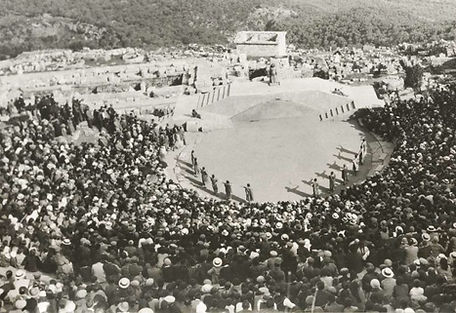
The ancient city of Delphi, home to the famed Oracle and Apollo’s temple, was revered as the spiritual heart of the Greek world. Delphi’s sacred status stretched back to the 15th century B.C., attracting pilgrims who sought guidance from the gods. According to Greek myth, Apollo claimed the shrine after defeating the serpent Python, cementing the site’s divine purpose.
THE ORIGINS OF THE DELPHIC GAMES
In celebration of Apollo’s victory and penance, the Delphic Games—also known as the Pythian Games — were founded in 582 B.C. as peaceful contests held every four years, a year before the Olympics. Unlike the Olympics’ focus on athletics, the Delphic Games, organized by the Amphictyony (a council of twelve Greek clans), honoured Apollo with competitions spanning music, painting, drama, and dance—arts regarded by contemporaries as even more magnificent than sport.

DELPHIC GAMES- TRUCE TIME
During the sacred period of Delphic Peace, all weapons were set aside, ensuring a festival marked by safety, cultural exchange, and spiritual growth. This period of peace was so respected that even Aristotle wrote about the grandeur and importance of these harmonious gatherings. The celebration spanned 6-8 days, with a procession, feasts, and competitions in Delphi’s theatre, stadium, and surrounding areas. Laurels crowned the victors, and for some, statues were erected in their honour. Victories brought immense pride and prestige to the athletes’ home cities, while the Games themselves drew crowds and prosperity to Delphi. The tradition, however, ended in 394 A.D. when Emperor Theodosius banned all such festivals as pagan.
THE ORACLE OF DELPHI
The Oracle of Delphi or Pythia was the most celebrated and influential shrine of ancient Greece, renowned as the centre—the “omphalos”—of the Greek world. Situated at the Temple of Apollo, the oracle was embodied by the Pythia, the high priestess who entered trance states to deliver cryptic prophecies believed to be divinely inspired by Apollo. Leaders, citizens, and pilgrims journeyed from across the Mediterranean seeking advice on matters ranging from politics and warfare to personal dilemmas, and her pronouncements often shaped crucial historical decisions, including the course of wars and the foundations of Greek city-states.
.jpeg)
.jpeg)
The sanctuary at Delphi also hosted the Delphic (Pythian) Games and 32 became a renowned hub for intellectual, religious, and artistic exchange until its decline under Roman rule and eventual closure with the rise of Christianity. Throughout more than a millennium, the Pythia stood at the core of Delphi’s power and allure. These priestesses, chosen for their moral character, lived apart from familial ties, bathed in the sacred Castalian Spring, and delivered Apollo’s guidance—sometimes in trance—on everything from matters of state to personal destiny. This powerful institution drew the greatest minds and leaders of the ancient world to Delphi, ensuring its enduring influence on Western thought and history. Here is a more detailed and spaced timeline that includes the legacy of the Pythia and the legendary seekers who consulted her over a thousand years:
LEGENDS WHO CONSULTED PYTHIA
Across more than a millennium, the Pythia at Delphi was consulted by many of history’s greatest leaders and thinkers, shaping decisions that transformed the ancient world. Here are some of the most notable figures who sought her guidance:
-
Alexander ‘the Great’: Before launching his empire-building campaigns, Alexander visited Delphi in 336 B.C. and demanded a prophecy. Legend says the Pythia declared, "You are unstoppable, my son!" — which he took as divine affirmation for his conquests.
-
Pythagoras: was believed to have been deeply influenced by the Oracle of Delphi and the Pythia, Pythagoras was named after the Pythia because his parents, having consulted the Delphic Oracle, were foretold his birth and destiny by her. The Pythia’s association with divine wisdom and direct communication with Apollo strongly shaped Pythagoras’s orientation toward mysticism and the religious dimensions of his philosophy.
-
Socrates: The Athenian philosopher was declared the wisest of men by the Oracle, a pronouncement that led Socrates to a lifelong quest for wisdom and critical self-examination, forming the bedrock of Western philosophy.
-
Themistocles of Athens: Facing a Persian invasion in 480 B.C., Themistocles consulted the Oracle, who spoke of "wooden walls" saving Athens. Themistocles correctly interpreted this as advice to strengthen the navy, a strategy that led to victory at the Battle of Salamis.
-
Lycurgus of Sparta: The Spartan lawgiver sought the Oracle's endorsement for his famously strict reforms. The Pythia’s blessing legitimized his laws, shaping Sparta’s future and society.
-
Roman Emperors: Nero was cryptically warned to beware the "73rd year" (Galba, his successor, was 73 years old). Hadrian asked about Homer’s birthplace. Diocletian inquired about the Christian threat

The Oracle of Delphi was truly the heart of ancient Mediterranean decisionmaking, its wisdom and mystery revered throughout history. The Pythia’s wisdom guided military, political, and personal decisions, making Delphi the true “navel of the world” and a centre of ancient insight and diplomacy.
ANCIENT TIMELINES

-
4000 B.C.: Earliest settlements at Delphi; future site of Athena Pronaia’s shrine
-
1500 B.C.: Worship of Gaia, the Earth goddess, with Python as her guardian
-
1200 B.C.: Apollo claims the shrine after defeating Python, establishing the sacred precinct.
-
800 B.C.: Delphi rises as the spiritual and political centre of Greece; the institution of the Pythia, the high priestess who channels Apollo’s prophecies, soon becomes pivotal. For nearly a millennium, the Pythia delivers oracles from the Temple of Apollo, guiding pilgrims and powers alike

-
600 B.C.: Temple of Apollo is rebuilt by the Alkmenoid family
-
582 B.C.: Delphic (Pythian) Games are formalized, blending peace and artistic competition.
-
518 B.C.: Birth of Pindar, whose poetry immortalizes Pythian victors and the grandeur of Delphi
-
480 B.C.: Persian Wars bring destruction and renewal to Delphi.
-
398 A.D.: Closure and destruction of the Oracle-Temple; last prophecy delivered as Christianization sweeps the empire.
-
1892: Modern archaeological excavations begin at Delphi.
REVIVAL IN THE MODERN ERA
The Oracle of Delphi was truly the heart of ancient Mediterranean decisionmaking, its wisdom and mystery revered throughout history. The Pythia’s wisdom guided military, political, and personal decisions, making Delphi the true “navel of the world” and a centre of ancient insight and diplomacy.
MODERN TIMELINES
-
1994: First modern Symposium on the Delphic Games revival in St. Petersburg and founding of the International Delphic Council in Berlin.
-
1995: First National Delphic Council in Nigeria.
-
1997: First Junior Delphic Games, Tbilisi, Georgia.
-
2000: First Delphic Games in Moscow.
-
2003–2023: Junior and adult Games, Summits in Düsseldorf, Kuching, Jeju Island, Athens, New Delhi, Kolkata
-
2025: IDC relocates to Athens—the eternal home of the Delphic legacy